Biography
Wenyan Wu is a Chinese photographer. His work moves between intimate, private observation and traces of reality in public space, attending to how individuals enter, move through and temporarily occupy the world around them, and how space continues to preserve evidence of their presence after they have left.
Memory, identity, migration and belonging are recurring concerns in his practice. Rather than constructing complete, linear narratives, he begins with fragments encountered by chance: obscured faces, bodies leaning on one another, crowds in the rain, empty seats, water gathered at the edge of a road, or a figure about to slip out of the frame. These small and uncertain moments form a visual narrative suspended between documentary fact and personal perception. The human figure does not always appear as a clearly defined subject, but may instead be sensed through a gesture, a shadow, an object left behind or a change made to a space.
Animals and nature recur throughout his work, but not simply as objects to be observed and recorded. A bird suddenly crossing the frame, branches extending outwards, and the juxtaposition of organic forms with urban infrastructure offer another scale of attention. Through nonhuman life and movement, the photographs reconsider how people draw boundaries, establish order and organise their surroundings. Nature is not presented as the opposite of the city, but as a force that continually enters, interrupts and even redefines constructed space.
His gaze often rests on moments that have not yet settled into a conclusion. Bodies in motion dissolve into outlines through blur; flash makes trees at night appear unfamiliar; inverted colour turns ordinary scenes into almost spectral presences. In images of public events, flags, signs and crowds reveal complex relations between identity, power and belonging through partial obstruction and spatial distance. These visual shifts briefly remove everyday reality from its usual context, producing unstable images poised between fact, memory and imagination.
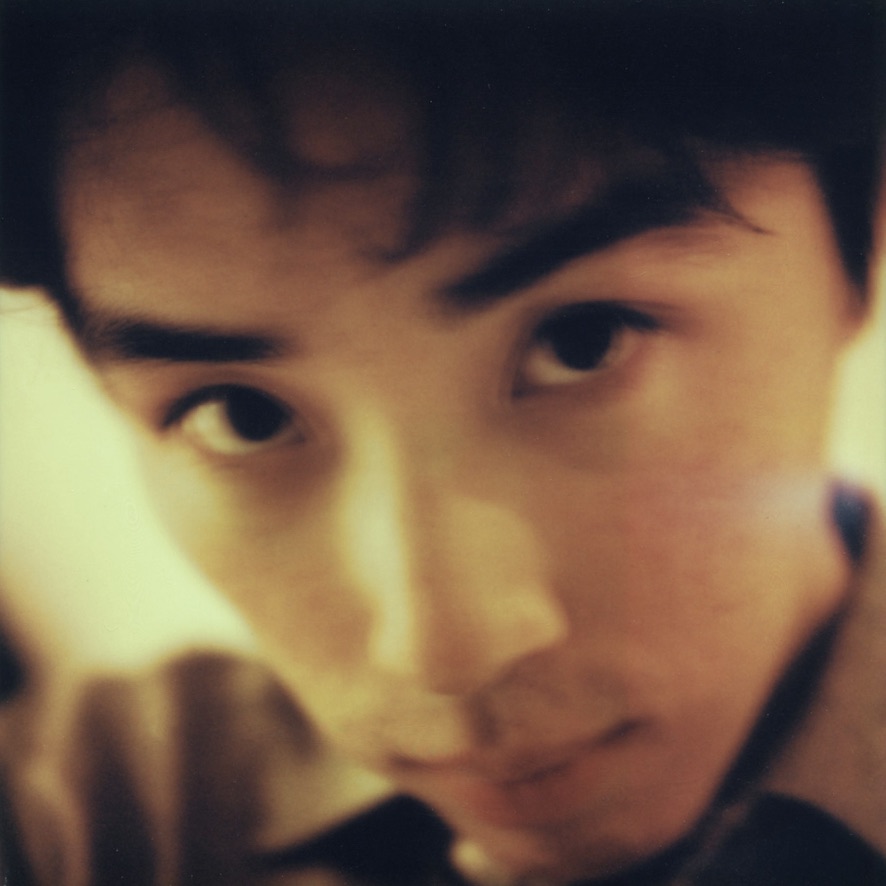
Polaroid is an important part of Wu’s visual language. Its soft focus, colour shifts, accidental exposures and never fully controllable process allow photography to become more than a clear representation of reality: it becomes a material, time-bound carrier of memory. From the moment an image appears, it already contains the possibility of fading, distortion and disappearance. Alongside it, high-resolution medium-format photography introduces a slower and more deliberate mode of looking, rendering scale, surface, spatial depth and the distance between figure and environment with greater precision.
These two media are not opposites, but together shape his way of seeing. One approaches the blurred, mutable and emotional texture of memory; the other attempts to preserve the details of reality through calm, exact observation. Between clarity and ambiguity, presence and absence, documentation and perception, his photography resists immediate explanation and keeps space open for experiences that have been overlooked, obscured or remain unfinished.